Community Investment Fund, Resources to Start, Learn & Build
Community Investment Funds (CIFs) are locally managed investment funds designed to keep capital rooted in the communities they serve.
Whether you’re just getting started or ready to build, NC3 provides a full set of resources to guide you through the process. Begin with the Starter Workbook to shape your vision, explore the Handbook to understand models and structures, and use the Toolkit to access practical resources for implementation.
Together, these tools are designed to make community investing more accessible, action, and impactful.
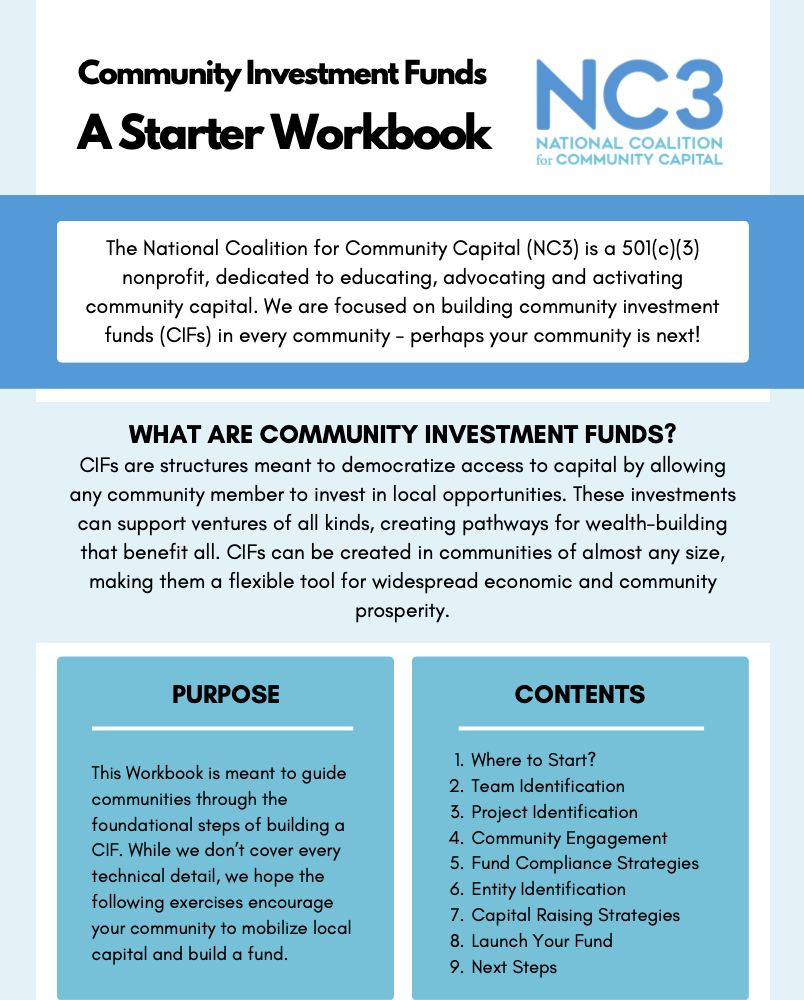
The Starter Workbook
A guided, hands-on workbook designed to help you take the first steps toward building a community investment fund in your own context.
Inside you’ll find practical exercises and tools to help you:
Clarify your purpose and vision
Identify early partners and build your team
Engage your community and surface local priorities
Explore structure, compliance, and legal basics
Plan for raising and deploying local capital
Move from planning to action
This workbook doesn’t cover every technical detail, but it will help you build momentum, make progress, and lay the foundation for a fund that reflects your community’s values and drives local impact.
Our CIF Handbook illustrates a wide range of approaches you might apply to build your own CIF. It is not a call to action, but a manual for those who have already been called. In it, we:
explore short profiles of 10 funds that showcase the wide range of models and experiments underway
describe the basic steps a community needs to take to develop a CIF
provide a comprehensive legal primer on the types of community investment funds currently possible
Point readers to a list of books, articles, organizations, law firms, and others that can assist you in your effort to launch a CIF
Our CIF Toolkit is a collection of resources to help you develop your own community investment fund. It includes explainer videos and downloadable worksheets to get you started, including a Team Builder Matrix, Investment Thesis Worksheet, Fund Calculator, Operating Structure Checklist, and Financial Modeling Guidelines. The Toolkit acts as a complement to “Chapter 2: Steps to Create a Community Investment Fund” of the Handbook.
These resources illustrate the belief that inspiration should fuel the launch of community capital funds, but perspiration will be needed to keep them running. At the same time, we know that the field will not scale if we are sweating alone. Thus, as a community of practice, we endeavor to share our learnings so that all of us can spend less time building models and more time building community. To join a listserv of CIF practitioners, fill out this form.